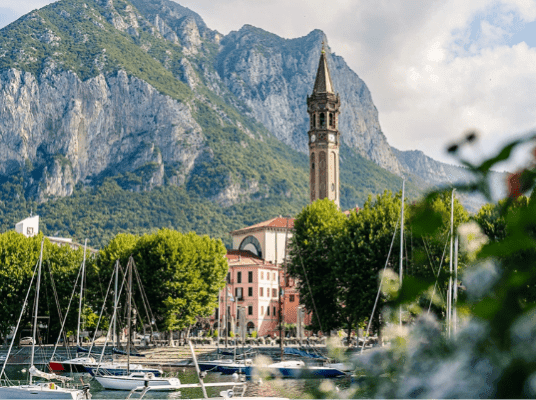
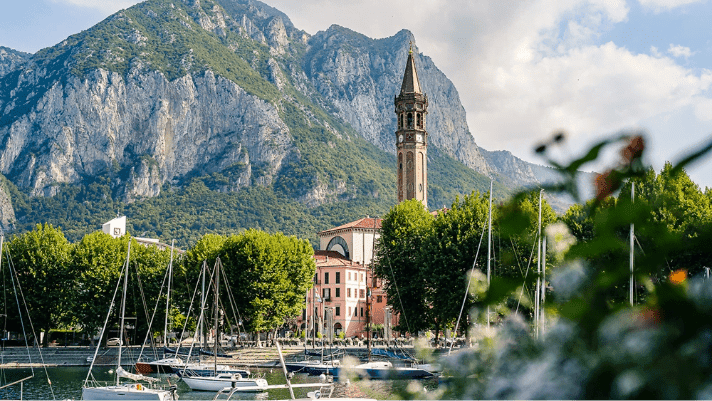
With its hamlets of Onno, Vassena and Limonta, Oliveto Lario is a true gem nestled along the Olive Grove Coast, bringing together everything that makes this branch of Lake Como so captivating. Olive trees have been cultivated here since Roman times; beaches framed by woods and mountains meet crystal-clear waters over beds of pebbles and fine gravel; the historic Circuito del Lario links the area to the world of international motorcycling; and churches, historic chapels and sanctuaries—including the iconic Madonna del Moletto—tell of a rich past and an ancient popular spirituality deeply rooted in local identity. And then there are the trails: some demanding, climbing towards the mountain peaks, others cutting across the steep shoreline before descending all the way to the waters of the lake.
The hamlet of Onno lies on the Circuito del Lario, a loop that once hosted a famous motorcycle road race created by the Moto Club Lombardo. Riders such as Pietro Ghersi, Tazio Nuvolari, Tonino Benelli and Omobono Tenni competed here, while along the SP 583 road memorial plaques commemorate those who lost their lives on the circuit. Another notable landmark is Casa Corti, the former parish house, where you can see the remains of an ancient fresco on the south-east façade, dated 2 December 1452 and attributed to Cristoforo da Seregno and his workshop. The same artists are also credited with the frescoes decorating the apse of the nearby parish Church of San Pietro and the north wall of the Church of Sant’Anna.
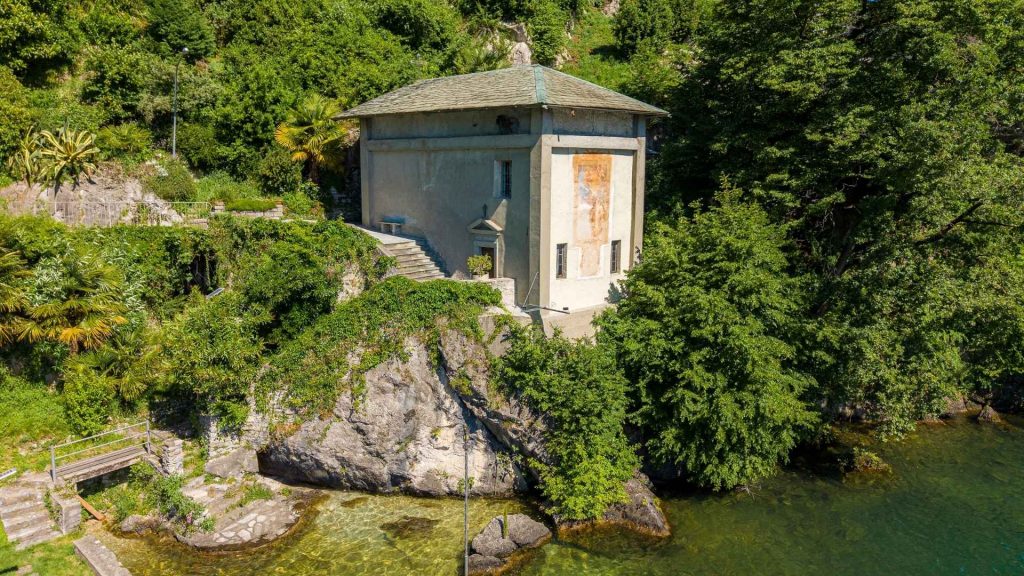
Among Oliveto Lario’s most distinctive places of worship is the Sanctuary of Our Lady of the Annunciation, known as Madonna del Moletto. This small 17th-century church, built on two levels and decorated with an important cycle of frescoes, enjoys an enchanting position overlooking the lake. It has become famous not only for its extraordinary beauty, but also for the many miracles traditionally associated with it. Each of Oliveto Lario’s hamlets has its own sacred places and traditions: in Onno, you will find the Church of San Pietro da Verona, or Saint Peter Martyr, with its many valuable works of art; in Vassena, the Church of Santi Nazaro e Celso, with later decorative paintings by Davide Beghè; and in Limonta, the Church of Santi Ambrogio e Bernardo, whose Baroque interior features a late-15th-century polyptych depicting the Crucifixion and paintings attributed to the workshop of the Recchi brothers.
With white pebbles, fine gravel and crystal-clear waters, most of Oliveto Lario’s beaches are free to access. A belt of poplars, alders and willows separates the road from the shoreline, providing welcome shade and creating a wonderfully unspoilt atmosphere for anyone seeking a closer connection with nature. The beaches at Onno are particularly popular for their sunny position and views across the lake to the villages on the opposite shore. Here you can enjoy a long, refreshing swim, savour an artisan gelato while taking in the mountain views, or raise a glass at sunset in an atmosphere of complete peace and relaxation.


The Olive Grove Coast is the stretch of Lake Como between Lecco and Bellagio, with Oliveto Lario lying almost exactly halfway between the two. The town’s very name reflects its long tradition of olive growing, with groves cultivated on the characteristic terraces that have helped shape the identity of this part of the lake. Favoured by a mild climate and morainic soil, olive cultivation has exceptionally ancient roots here: introduced in Roman times and refined over the centuries, it now produces high-quality extra virgin olive oil protected by the Laghi Lombardi–Lario PDO designation. To immerse yourself in the aromas, flavours and atmosphere of this enchanting stretch of Lake Como, follow the famous Sentiero degli Olivi (Olive Grove Trail), an extensive network of walking routes running along the entire Oliveto Lario shoreline, through vertical rock faces and limestone caves, cultivated terraces, pastures and woods of chestnut, hazel, hornbeam and oak.
Oliveto Lario has an extensive network of trails climbing from the lake towards woodlands, alpine pastures and panoramic mountain slopes, with routes for different levels of ability. The network connects all the main hamlets and includes both moderately challenging hikes, often following ancient mule tracks, and steeper, more exposed routes intended for experienced hikers. There are circular and point-to-point options of varying length and elevation gain, leading towards places such as Crezzo, San Giorgio, Alpetto, Chevrio, Valbrona and Ghisallo, with sweeping views over the lake, the Grigne and Mount Resegone.




Ask us, we will give you suggestions and directions to enjoy the city and the surrounding area to the fullest.
Contact us