









Ferrata Gamma 1
A mountaineering experience in the Lombardy Prealps
Lecco has a unique tradition in the Alpine landscape: here, via ferrata routes are not merely sporting itineraries, but a direct evolution of the local ingenuity in ironworking. Chains, ladders and iron pegs, once produced locally in the city’s workshops, transformed legendary rock faces into accessible routes, now completely upgraded to meet the latest safety standards. Climbing a via ferrata in Lecco means following in the footsteps of great mountaineers such as Walter Bonatti and Carlo Mauri, surrounded by a landscape where the limestone of the Grigne and Resegone mountains plunges directly into the waters of Lake Como.
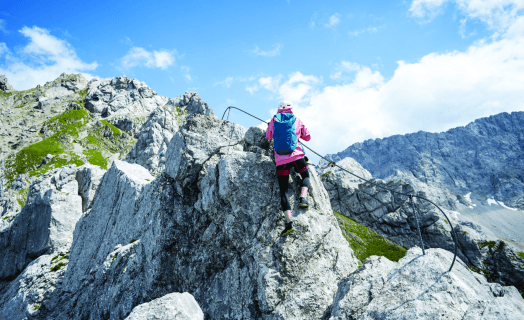
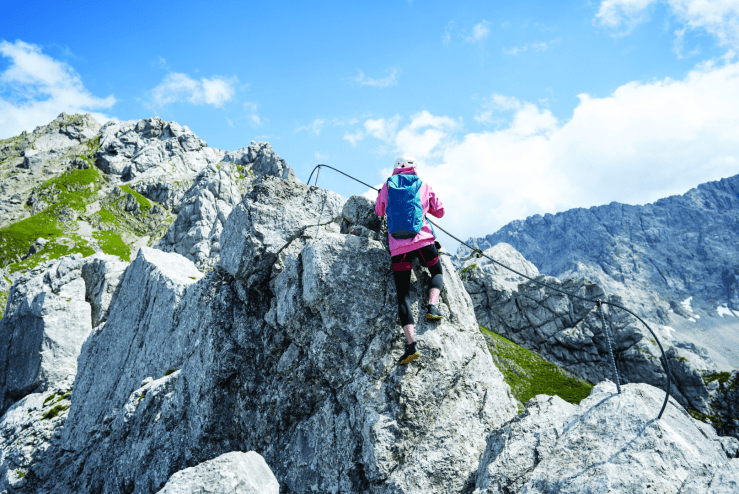
Among the cliffs overlooking the city, the Gamma 1 via ferrata on Pizzo d’Erna (EEA – D) is an essential classic. Although its technical difficulties are moderate, its considerable elevation gain (600 m) makes it challenging and highly atmospheric, with a steep first section featuring numerous metal ladders suspended above the city. An escape route halfway along the route leads to Rifugio Stoppani.
For those seeking the highest level of technical difficulty, the Gamma 2 on Resegone (EEA – TD) is considered one of the most difficult routes in the Alps. It is an itinerary for experienced climbers, alternating exposed ledges with very steep, highly exposed rock faces. The key section is a vertical “chimney dihedral” requiring excellent climbing technique before reaching the summit of Dente at 1,810 metres.
Resegone also offers more accessible options, such as the Centenario (EEA – PD) and Franco Silvano (EEA – PD). The former climbs narrow gullies in an exceptionally scenic setting, while the latter leads to the summit of Punta Cermenati, ending at a panoramic viewpoint.
Finally, the Medale via ferrata (EEA – D) should not be overlooked. This technical route climbs the majestic face of Corno Medale, with a continuous metal cable throughout, supported by footholds on the more demanding sections. The route is highly technical and finishes with an equipped path leading to the summit cross at 1,029 metres.
Moving towards Valsassina, the landscape becomes wilder and more mountainous. The Simone Contessi via ferrata (EEA – D) on Monte Due Mani crosses eight different rock towers, with a key overhanging section known as the “Torrione della discordia”, which tests hikers’ strength. At Piani di Bobbio, meanwhile, you will find Zucco Pesciola (EEA – TD), characterised by a vertical bastion and a strenuous high-altitude dihedral, and Mario Minonzio (EEA – D), a highly panoramic ridge route that includes technical sections even on the descent before reaching the summit of Zucco Campelli.
The Corni di Canzo also offer a taste of vertical adventure with the via ferrata routes of Lecco Brianza. The 30° OSA on Corno Rat (EEA – D) is renowned for its challenging slab and suspended panoramic ledge, while the Venticinquennale (EEA – D) climbs Corno Occidentale via a distinctive gully-dihedral featuring a deep crack and a ten-metre vertical ladder.
Unique of its kind, the Galleria di Morcate via ferrata (PD, with variants up to AD) in Varenna is a moderately difficult route with an unusual start directly from inside a road tunnel. It is a short route (less than an hour) but highly atmospheric, as it runs high above Lake Como. Despite its brevity, it features overhanging rock faces and athletic sections requiring upper-body strength, as it is almost entirely equipped with footholds and chain.
Safety and tips for your ascent
Tackling Lecco’s via ferrata routes requires awareness and the correct equipment. A full via ferrata kit (harness, helmet and via ferrata set with energy absorber) is mandatory, and you should always check the weather forecast, avoiding the ascent in the event of thunderstorms. For beginners, support from the Alpine Guides is essential for learning belaying and climbing techniques in complete safety.
Tackling the via ferratas in Lecco requires awareness and the correct equipment. The use of a full kit (harness, helmet and via ferrata set with energy absorber) is compulsory, and it is recommended that you always check the weather forecast, avoiding the climb in the event of thunderstorms. For beginners, the support of Alpine Guides is essential for learning belaying and climbing techniques in complete safety.

Ask us, we will give you suggestions and directions to enjoy the city and the surrounding area to the fullest.
Contact us